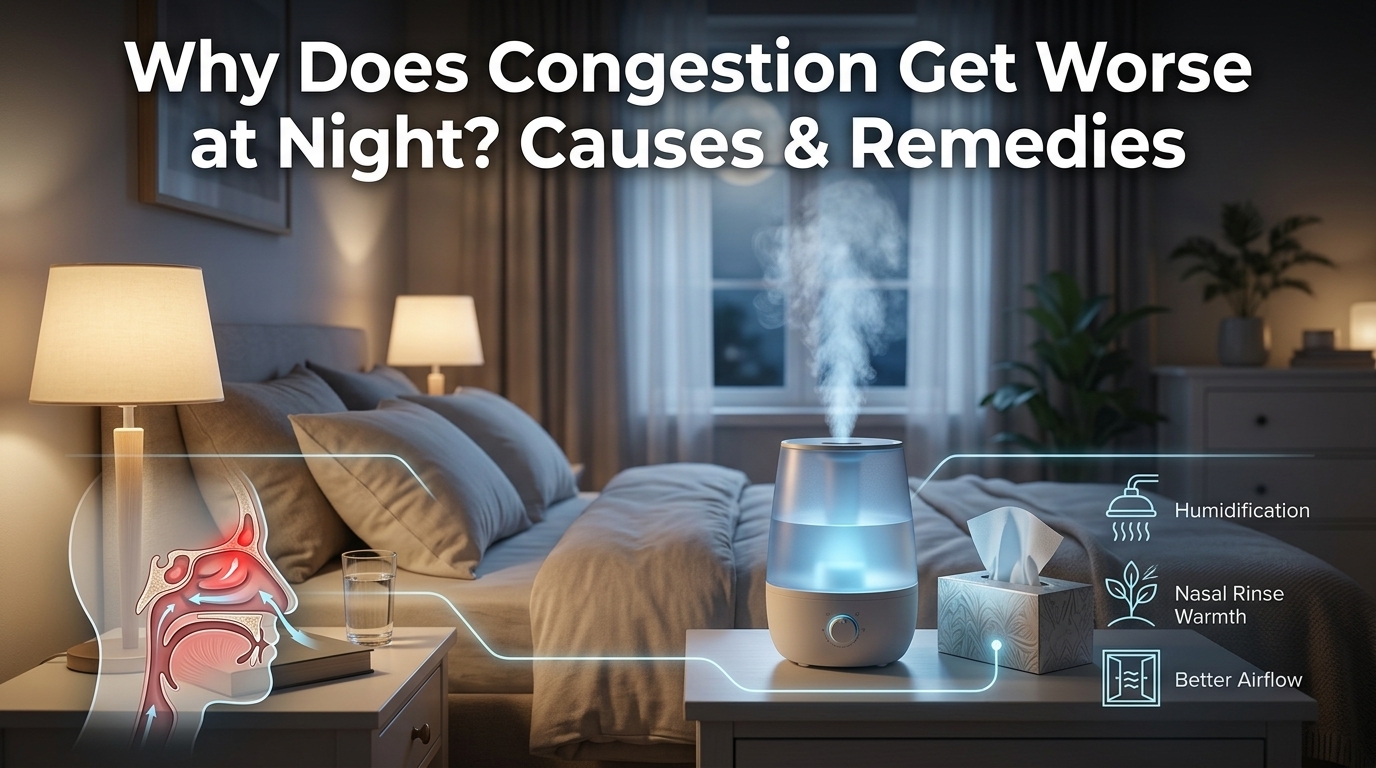
Tossing and turning while struggling to breathe through a blocked nose is one of the most frustrating sleep disruptions a person can face. You might manage a head cold, seasonal allergies, or sinus pressure reasonably well throughout the day, only to lie down and suddenly find yourself completely unable to draw air through your nostrils. Many people find themselves lying awake asking why does congestion get worse at night when the physical symptoms were manageable just hours earlier. This shift is not an illusion or a coincidence; it is the direct result of biological, environmental, and physical changes that occur when your body transitions from daytime activity to nighttime rest.
Addressing evening nasal blockage requires looking beyond simple symptoms to understand how human physiology responds to recumbent posture, shifting circadian rhythms, and closed bedroom environments. When individuals ponder why does congestion get worse at night, they are often dealing with a combination of blood volume redistribution in nasal tissues, natural hormonal drops, dry indoor air, and accumulated environmental allergens in bedding. Leaving these causes unaddressed leads to fragmented sleep, morning fatigue, chronic mouth breathing, and dry throat irritation, creating a cycle that hinders daytime performance and delays physical recovery.
This guide provides an overview on why your nasal passage feels more blocked up at night helping to clear up your nighttime congestion and lead you back to a peaceful night of sleep. We are sticking to the specialized content display rules therefore the entire content will be shown in paragraphs with no bullet points, numbered lists, tables, or paragraph non-structured formatting.
The Physics of Posture and Blood Redistribution
The most immediate catalyst behind nocturnal nasal swelling involves basic physics and gravity. During daylight hours, when you stand or sit upright, gravity naturally pulls blood and interstitial fluids downward toward your lower extremities. This downward pull prevents excess venous pooling inside the delicate, highly vascular mucous membranes that line your nasal passages.
When you transition to a lying position, gravity no longer assists in drawing fluid away from your upper body. Blood volume redistributes evenly throughout your torso and head, leading to increased vascular pressure inside the nasal turbinates. These sensitive tissue structures swell significantly as local blood vessels dilate, causing the inner dimensions of your nasal airways to narrow drastically. This gravitational shift is a primary physical reason why does congestion get worse at night the moment your head hits the pillow.
In addition, being in a prone position has the tendency to inhibit normal clearance mechanisms. Our normal postnasal drainage trickles down our throat during the day without a thought and simply getswallowed. Lying in a prone position accumulates mucus within our posterior nasal cavity and our uppermost reaches of the throat, leading to itchy coughs, throat clearing, and immense pressure in the face which prevents you from sleeping.
Circadian Rhythms, Cortisol Shifts, and Immune Activity
Beyond physical posture, your internal biological clock heavily influences how your respiratory system behaves after dark. Throughout the daytime, the adrenal glands produce higher levels of cortisol, an anti-inflammatory hormone that keeps blood vessels naturally constricted and suppresses excessive immune reactions. Cortisol levels peak in the early morning hours to help you wake up and gradually drop to their lowest point around midnight.
As circulating cortisol declines in the evening, natural anti-inflammatory suppression fades, allowing immune pathways to become more active. Blood vessels inside the nasal passages dilate freely, and localized inflammation increases, leading many individuals to wonder why does congestion get worse at night even when they remain sitting up in bed reading or watching television. This hormonal shift is part of the body’s natural repair cycle, but it inadvertently exacerbates tissue swelling in inflamed sinus cavities.
Simultaneously, the parasympathetic nervous system takes over during rest, slowing heart rate and altering vascular tone across organ systems. Increased parasympathetic activity encourages vasodilation in erectile nasal tissues, a natural mechanism meant to warm and humidify incoming air. In a healthy system, this internal shift goes unnoticed, but when sinus tissues are already swollen from a cold or allergies, parasympathetic dilation drives air resistance to uncomfortable levels.

Micro-Environments and Bedroom Allergen Exposure
The physical space where you sleep plays an equally significant role in driving nighttime airway resistance. Bedrooms often harbor concentrated micro-environments containing dust mites, pet dander, mold spores, and textile fibers that accumulate in mattresses, pillows, and heavy blankets, all of which can affect indoor air quality. Spending seven to eight hours continuously breathing in close proximity to these microscopic triggers creates a continuous allergic response.
Throughout the day, moving between different ventilated rooms prevents prolonged exposure to localized air pollutants. Once you settle into bed, your face rests directly against fabric surfaces that may hold thousands of microscopic dust mite droppings. For sensitive individuals, this intense, sustained allergen exposure causes mast cells in the nasal lining to release histamine, answering the frequent question of why does congestion get worse at night specifically inside the bedroom.
The other component to nighttime nasal congestion from your bedroom systems is that they often leave behind or actively create low overnight relative humidity. This dry air dehydrates your sensitive nasal mucous membranes; the membrane becomes tender, swollen, and reflexively produces an overload of dense, tacky mucus for protection. It’s the synergy between dryness and highly concentrated indoor allergens that transforms the bedroom into a critical trigger for severe overnight congestion.
Gastroesophageal Reflux and Silent Upper Airway Irritation
An underdiagnosed contributor to evening nasal inflammation involves gastroesophageal reflux, specifically a condition known as laryngopharyngeal reflux or silent reflux. When you lie flat after eating a late dinner or snacking before bed, stomach acid and digestive enzymes can easily travel backward up the esophagus into the delicate tissue of the throat, nasopharynx, and posterior nasal cavity.
Unlike classic heartburn, silent reflux does not always produce a burning sensation in the chest. Instead, microscopic droplets of stomach acid irritate the lining of the upper respiratory tract, causing localized tissue swelling, chronic throat clearing, and increased mucus production. Drivers of airway irritation like silent reflux provide a compelling explanation for why does congestion get worse at night in individuals who do not show typical signs of seasonal allergies or viral colds.
Overnight meal – the big (or for some of my most dedicated clients, several binges of) alcohol at end of day, keep your stomach contents agitated at bedtime, where they then irritate, on a micro-scale, your upper airways. The tissues of your nose are swollen and supersensitive for hours on end, as the agonies contribute to those provided by both gravity and low nighttime cortisols. Meals and bed-lifting should considerably allay this specific stimulus.
Practical Nighttime Interventions and Environmental Control
Overcoming evening nasal blockage requires a multi-faceted approach combining posture adjustment, environmental cleaning, and targeted therapy. To combat gravitational fluid pooling, elevate the head of your bed using a wedge pillow or bed risers to keep your head and chest angled four to six inches above your lower body. This slight incline reduces venous pressure in the nasal turbinates and allows gravity to assist in natural mucus drainage throughout the night.
Managing indoor air quality is equally vital for long-term relief. Using a clean cool-mist humidifier maintains indoor relative humidity between forty and fifty percent, preventing delicate nasal membranes from drying out and overreacting. Running a high-efficiency particulate air purifier near the bed traps floating dust mites, pet dander, and pollen before they reach your airways, addressing environmental factors that lead people to ask why does congestion get worse at night.
And the quick and easy benefits of a relaxing bedtime routine may work wonders for your health as well: 20 minutes before bed take a hot steamy shower. That steamy shower will thin the thickened mucus and moisturize the inflamed tissues in the nose. A saline nasal wash or nasal spray just before going to sleep will help clear out nasal passages of any mucus, dust or allergens that may have settled there during the day and will cause a sudden abrupt awakening.
Common Pitfalls and Medication Usage Warnings
While seeking fast relief from severe evening blockages is understandable, certain common treatments can backfire and worsen symptoms over time. The most frequent mistake is the prolonged, overuse of over-the-counter decongestant nasal sprays containing active ingredients like oxymetazoline or phenylephrine. While these sprays constrict blood vessels rapidly to provide dramatic short-term opening, using them for more than three to five consecutive days causes a severe rebound effect known as rhinitis medicamentosa.
When rebound congestion strikes, the blood vessels in the nose become completely dependent on the spray to constrict, expanding back to an even more swollen state as the medication wears off. This creates a frustrating cycle where an individual uses sprays every night just to breathe, compounding the original reason why does congestion get worse at night with chemical dependency. Over-the-counter decongestant sprays should be reserved strictly for short-term, emergency use during acute illness.
The misuse of drowsy antihistamines to try and help induce sleep in someone who is having difficulty breathing. Older style antihistamines can produce a drowsy effect but may also have an anticholinergic action that dries out the nasal mucous and leave any secretions thick and inspissated (sticky) and thus impossible to clear from the nose. Non-drowsy long acting antihistamines or steroid nasal spray ( prescribed under the direction of a health professional) would control the inflammation at night time more reliably and without affecting nasal mucous clearance at night.
When to Seek Professional Evaluation and Advanced Care
While most instances of evening nasal congestion resolve with basic self-care and environmental management, persistent symptoms warrant professional evaluation by a physician or an otolaryngologist. Chronic nighttime breathing difficulties that last for months can indicate underlying structural issues such as a deviated nasal septum, nasal polyps, or enlarged turbinates that physically restrict airflow regardless of posture or air quality.

Chronic mouth breathing at night due to unresolved night-time congestion significantly elevates your risk of snoring, upper airway resistance syndrome, and sleep breathing problems. If you experience both evening congestion and loud panting/gasping in sleep, headaches in the morning, non-refreshing sleep and daytime fatigue, book a sleep assessment or nasal endoscopy and guard your long-term cardiovascular health and metabolic status. Your primary care orENTprovider is able to prescribe targeted and long-term therapies specific to your airway anatomy and inflammatory triggers (e.g.
Prescribe steroid nasal sprays; prescription nasal antihistamines and personalized nasal allergy immunotherapy, or provide minimally invasive surgery to reduce turbinate size permanently).
Professional guidance is necessary to avoid the real issue behind why congestion gets worse at night and restore clear nasal breathing while you sleep for many years to come.