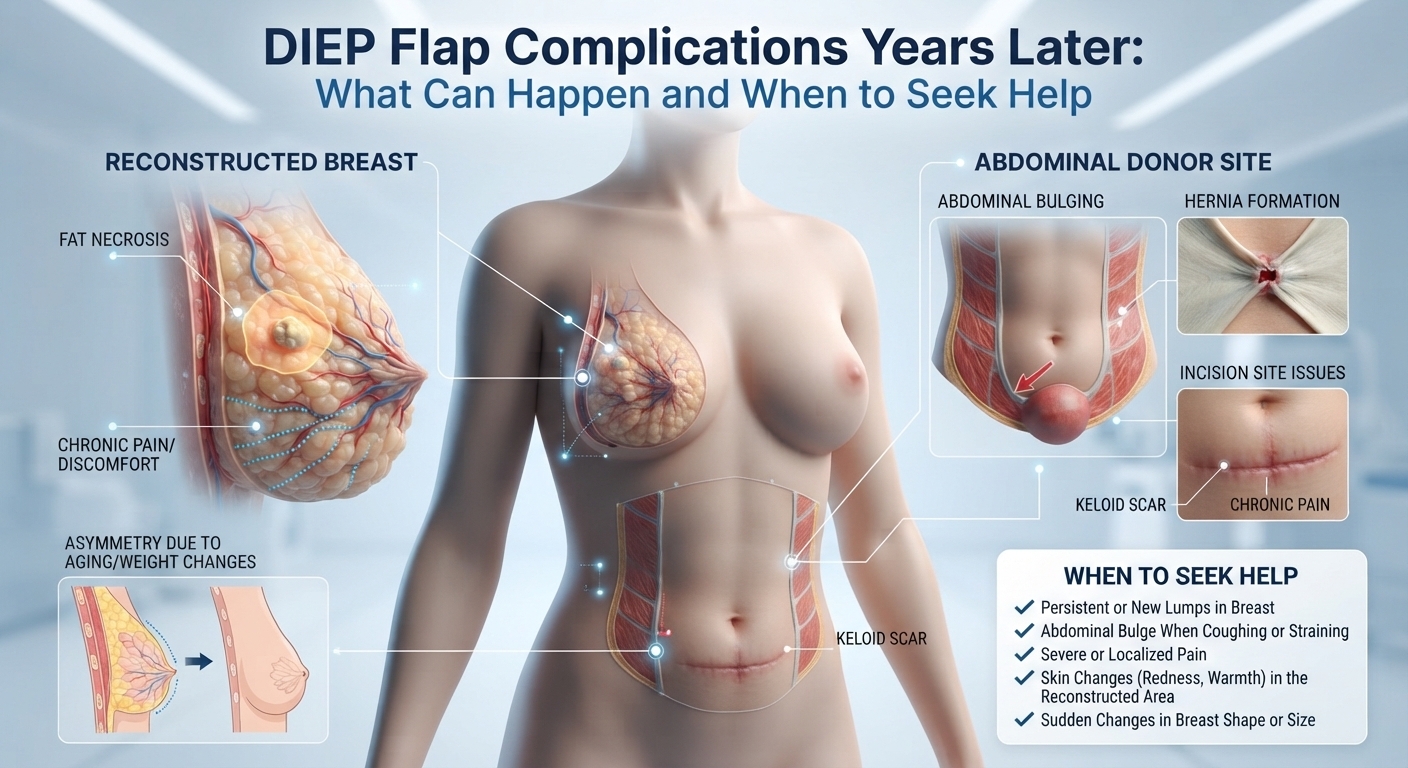
The DIEP flap involves transplanting skin and fat from the abdominal wall to reconstruct the breast while leaving behind as much of the abdominal muscles as possible. For many, the recovery can be successful and the reconstructed breast is well tolerated. In a reconstruction that has been stable for a number of years, however, one may develop a new lump in the reconstructed breast, or the appearance may change, or the patient may develop abdominal pain or swelling.
The phrase diep flap complications years later usually refers to problems that become noticeable long after the original reconstruction rather than complications that occur during the immediate postoperative period. Some late changes are relatively minor and may only affect appearance. Others, such as an abdominal hernia or a new breast mass, deserve medical evaluation.
Crucially, a new symptom doesn’t mean your flap has necessarily collapsed. Lots of the late complications can be treated and many of the changes seen may be due to natural aging, changes in weight, scar tissue, or some totally unrelated illness. Thinking about the alternatives could highlight those that merit investigation and to discuss with your plastic surgeon.
What Is a DIEP Flap?
Understanding DIEP Flap Complications Years Later starts with knowing how the procedure works. TheDIEPor deep inferior epigastric perforator flap recreates a breast after mastectomy by transferring skin and fatty tissue from the abdomen. Instead of the muscles that are transferred with a conventional TRAM flap,this operationattempts to maintain therectus abdominalismuscle. The supplying blood vessels to the abdominal tissue are carefully cut from the muscle and then moved to the chest.
As this reconstructed breast consists of live tissue, it should adapt and evolve over time like the rest of your body.
Changes occur with aging and also through weight loss or gain, hormones, scarring and effects of previous chemotherapy. The issue about the tummy donor site does still continue to be a consideration years after the operation. By maintaining the abdominal muscle, the prospect of weakness of the abdominal wall are decreased compared with operations that remove more of the abdominal musculature; they do not totally exclude the likelihood of problems with abdominal wall.
A late concern therefore needs to be considered in two broad areas:
- The reconstructed breast and surrounding tissue
- The abdominal donor site
Some symptoms may involve both areas indirectly, particularly when scar tissue, changes in body composition, or abdominal-wall weakness alter the shape of the reconstruction.
Can DIEP Flap Problems Appear Years Later?
Yes. Not every complication occurs during the first few weeks or months after surgery.
Some issues associated with DIEP Flap Complications Years Later may actually have developed gradually. For example, a small area of fat necrosis may have been present earlier but become easier to feel as surrounding tissue changes. Similarly, if there was the beginning of a weakness in the abdominal wall, this would also be more apparent with the change in activity levels, weight, or workload. New processes could arise independently.
If a new lump was identified in the breast tissue it would not necessarily be due to the reconstruction; benign masses can arise in the reconstructed breast and women after a history of breast cancer still need to be monitored for recurrence of cancer. This is where that distinction is important; every new complication does not have to be treated as being a consequence of the surgery.
Common DIEP Flap Complications Years Later
Fat Necrosis and Firm Lumps
One of the more common recognizable problem to arise after breast reconstruction using the above tissue sources is fat necrosis. This develops when parts of the transposed fat does not achieve a good blood supply and therefore degenerates to become firmer, either rounded or irregular, in parts of the reconstructed breast tissue which have become firmer or softer compared to other regions. It may be mistaken for a breast tumor.
Fat necrosis may not necessarily result in breakdown of the whole flap of tissue and it simply means that the fatty tissue becomes harder to a degree, as described in fat necrosis after breast reconstruction.
All lumps must be checked at some point and not assumed to be fat necrosis even after examination; where required the patient will be asked for imaging investigation and occasionally biopsy is required.
Changes in Breast Shape or Symmetry
Shape of a reconstructed breast may fluctuate over time. For example, a variation in your weight. Since a DIEP flap involves living fat tissue, it’s prone to grow larger with increasing weight and vice-versa.
When considering DIEP Flap Complications Years Later, aging can also change the relationship between the reconstructed breast and the opposite breast. Skin elasticity naturally diminishes over time and the native breast tissue will necessarily differ from the reconstructed side.
Skin scarring as well as past radiation treatment can lead to a feeling of firmness and tightness or distortions in shape. Radiation does affect tissue that has been previously reconstructed and will also serve to make the tissue that you grew feel firmer and possibly tighter/smaller.
A subtle and gradual shift in the shape of either breast should not always be considered an emergency, however changes that occur suddenly warrant an examination.
Abdominal Bulging
Bulging can result from a weak or uneven abdominal wall. Your bulge might look like a pocket-like outward movement without an obvious disruption of the abdominal wall.
A patient may notice it more when standing, coughing or exercising, or with voluntary tightening of the abdominal muscles. Discomfort is possible, but aesthetics is often what concerns the patient more.
Since bulging can be due to multiple reasons such as muscle weakness, problems related to scar formation, and a hernia, a physical examination may help direct further studies. Further imaging might be deemed appropriate based upon the surgeon’s physical exam.
Abdominal Hernia
A hernia develops when the tissue bulges through the weak muscle area in the abdominal wall, and abdominal hernia symptoms and treatment can help explain why a new donor-site bulge should be evaluated.
The risk after diep reconstruction is far lower than in procedures where a significant amount of abdominal muscle is lost- but still possible. A hernia can be a soft or hard lump over the operated area. This lump or swelling becomes more obvious when you cough, or if you lift, stand, or bear down, and should get less noticeable when you are lying on your back.
When considering DIEP Flap Complications Years Later, pain, increasing size, tenderness, nausea, vomiting, or a bulge that becomes difficult to push back should be taken seriously. These symptoms can indicate a more urgent problem and warrant prompt medical assessment.
Persistent or New Abdominal Pain

Pain years after reconstruction has many possible explanations. Scar tissue, nerve irritation, abdominal-wall weakness, musculoskeletal problems, or an unrelated abdominal condition can all produce discomfort.
The character of the pain matters. Burning or electric sensations may suggest nerve-related pain, while discomfort associated with movement may point toward the abdominal wall or musculoskeletal structures.
Pain that is new, persistent, progressively worsening, or associated with a visible bulge should not simply be assumed to be a normal consequence of old surgery.
Why Can These Problems Develop So Late?
Late symptoms can have different mechanisms, and sometimes there is no single explanation.
Changes in Body Weight
The transferred tissue still contains fat, thus gain or loss in body weight results in the reconstructed breast changing. In the instance of large weight losses, this will have the effect of diminishing the breast, whilst weight gains can cause it to enlarge. It also needs to be remembered that in an operation for creating an abdomen using the tissue used for this reconstruction, gains in body weight will have a reciprocal effect.
Aging and Tissue Changes
No matter how good the reconstruction, aging will occur. The skin has a loss of laxity over time, the scars mature, and the body composition alters. The natural breast droops and the reconstructed breast changes at an even higher rate making asymmetry evident not immediately after surgery.
Scar Tissue
Scar tissue can remain firm or become more noticeable with time. Internal scarring may affect how the breast feels even when the skin looks normal.
Scar-related tightness can also contribute to discomfort or restricted movement in some people.
Previous Radiation
Irradiation can affect the behavior of the reconstructed tissue. It can make the breast feel harder, retract or change shape, depending on the timing and reaction to radiation therapy.
A person who had radiation should always document that on the occasion of new changes.
Abdominal Wall Changes
Even though the Ab muscle remains intact with an average DIEP, a fair amount of tissue manipulation around the anterior abdominal wall and blood vessels does take place. The healing and scarring as well as exercise, further operations and changes to the body structure over time may all have an affect on the donor site.
How Can You Tell if a Lump Is Fat Necrosis or Something More Serious?
It is not usually possible to be able to reliably predict by feel what a new lump may be.
Fat necrosis can present as a firm, palpable lump and so can recurrent breast cancer, or other breast problems. Reconstructions can sometimes present as a new lump with a different feeling one due to its scar tissue content and the nature of its transplanted fat, making it very difficult to assess at self-examination.
The clinician will normally begin with a physical examination then image depending upon where it is felt, what is seen and felt, especially when assessing breast lumps and changes after reconstruction. Appropriate tests will be dictated by circumstances and these may include ultrasound of the area (particularly for looking at the nature of what has been felt), a mammogram (in the appropriately contoured tissue), MRI or biopsy.
The advice is therefore very simply this-any new, expanding or changing or lumps should be checked rather than merely put down to fat necrosis, especially in those who have had breast cancer before.
What Should You Do If You Notice a New Problem?
A practical approach is to document what you are noticing and arrange an appropriate clinical evaluation.
1. Identify the Change
Pay attention to whether the problem involves the breast, abdominal donor site, scar, or several areas.
Note when you first noticed it and whether it is changing.
2. Observe Associated Symptoms
Consider whether there is:
- Pain or tenderness
- Swelling
- Redness or warmth
- A new lump
- A visible bulge
- Changes in breast size or shape
- Skin changes
- Numbness or altered sensation
- Symptoms that worsen with coughing or physical activity
These details can help your healthcare professional determine what needs to be investigated.
3. Contact the Appropriate Clinician
For a new breast or reconstruction-related change, your breast surgeon, plastic surgeon, oncologist, or primary care clinician may be an appropriate starting point.
If the concern is primarily an abdominal bulge or suspected hernia, a surgeon may be needed for evaluation.
4. Follow Through With Recommended Testing
Do not skip imaging simply because a previous examination was normal. A new finding is evaluated according to what is happening now.
Previous records can be helpful because they allow clinicians to compare the current appearance with earlier examinations or imaging.
Common Mistakes to Avoid
A key pitfall is not considering the possibility that the surgery can be related to a problem which occurs many years later. Some late complications do occur, although many procedures are successful long term.
Conversely the surgical flap is often considered responsible for every new problem. A lump in the breast is can be fat necrosis, scar tissue or a benign or malignant growth; while abdominal pain can be from the operative site, but may have no relevance to surgery.
The symptom should be considered as a possible consequence of surgery, but its true relevance should be established with your surgeon.
Another problem is having the idea that if there is nothing really wrong, the symptom can be put up with. Changes which are just slight or slow to develop need to be brought to medical attention.
It is also commonplace for the patient to aggressively massage the area or exercise vigorously if they have either a bulge or lump in the breast and abdominal cavity, without knowing what has caused this.
When Should You Seek Medical Attention?

Not every late change warrants an urgent visit to the doctor’s, but some do require evaluation.
Get in touch with your doctor if you notice any new breast lump, or swelling of breasts that is not improving with treatment; new changes in breast shape; new change in breast skin and any breast lump that hurts. An abdominal bulge needs to be evaluated. If it is growing in size or is hurting this needs to be seen, if severe, then urgent medical attention.
If it gets hard, tender, looks strange, is reducing into the tummy and also comes with vomiting/ abdominal distress this is something that could be urgent for examination due to complication such as ischemia or infarction. Your new breast symptom can also warrant prompt review if other issues present, such as concerning changes of skin, and swelling.
Treatment Options for Late DIEP Flap Problems
So many of these late reconstructive problems have their own specific treatment depending on the cause; we’ll go into them here.
In cases of easily identifiable localized fat necrosis with no symptoms then follow up will suffice and even if it takes up a small area and the diagnosis is definite there is generally no treatment. In cases of uncertainty however further imaging or even biopsy may be needed.
Surgical removal, though uncommon, may be required to address significant pain or deformity of the rebuilt breast if it has occurred.
With the discrepancy in breast contour there is variable management; a surgeon may opt to discuss fat grafting, contouring or a reduction or contralateral adjustment to make it more appropriate for you.
Abdominal bulging or hernia should be viewed differently; mild weakness may well be expected and monitored but if it is an obvious, structural hernia requiring repair with surgery is very important.
Pain relief will once again vary from the actual pathology whether it is a neuralgic pain or a musculoskeletal issue, tightness around scar tissue or problems with the abdominal wall.
Therefore it makes more sense to find out what the cause of the symptom is rather than having one treatment.
Can Late Complications Be Prevented?
Not all long-term complications are preventable. Such factors as the surgical method, the patient’s own anatomy, the healing response, radiation/chemotherapy/cancer treatment, inherited tendencies, age and changes in body composition can have a long term effect on outcomes. Maintaining a constant or stable weight will contribute to a consistent outcome after a reconstruction; however weight loss will invariably affect body composition, hence impacting on the long-term result.
‘Normal’ activity and physical maintenance can assist overall well-being and functionality of the abdomen.
However one must not ignore surgeon instructions after reconstruction about rest and exercises, particularly core strengthening exercises, as the time window during which the new architecture can respond to directed exercises needs a timeframe to mature and remodel to optimal levels. Ongoing review is important, as even a long term reconstructed breast deserves due medical care when changes are noted; however awareness arguably the best prevention-you can learn when a true change is happening to your reconstructed breast and abdomen.
Frequently Asked Questions
1.Can a DIEP flap fail years after surgery?
Complete flap failure is primarily an early postoperative concern because the transferred tissue depends on its newly connected blood supply. Years later, a new lump, shape change, or other symptom does not automatically mean the entire flap has failed. Late problems are more often related to localized tissue changes, fat necrosis, scarring, radiation effects, abdominal-wall problems, or unrelated conditions.
2.Is fat necrosis common after DIEP reconstruction?
Fat necrosis is a recognized complication of autologous breast reconstruction. It occurs when part of the transferred fatty tissue does not receive adequate blood supply. It can produce a firm lump or irregular area. A new lump should still be evaluated because physical examination alone cannot always distinguish fat necrosis from other conditions.
3.Can you develop a hernia years after a DIEP flap?
Yes. A hernia can develop at the abdominal donor site after reconstruction, although the risk is generally lower with muscle-sparing DIEP techniques than with procedures that remove more abdominal muscle. A new or enlarging abdominal bulge should be examined to determine whether it represents a hernia or another type of abdominal-wall change.
4.Why does my reconstructed breast feel harder years later?
Possible explanations include scar tissue, fat necrosis, radiation-related tissue changes, or changes in the surrounding tissue. Hardness that is new, localized, progressive, or associated with a lump should be evaluated rather than assumed to be normal scar tissue.
5.Can weight gain or weight loss change a DIEP flap?
Yes. Because the reconstruction contains living fatty tissue, its size and contour can change with overall body-weight changes. The abdomen and natural breast can also change at different rates, potentially affecting symmetry.
6.Should I see a doctor for a new lump years after reconstruction?
Yes. A new or changing lump should be assessed, even if you previously had fat necrosis or other benign findings. Your clinician can compare the current finding with your previous examinations and determine whether imaging or additional testing is appropriate.
Conclusion
DIEP flap complications years later can involve the reconstructed breast, abdominal donor site, or tissues affected by previous cancer treatment. Fat necrosis, scar-related firmness, changes in breast shape, abdominal bulging, hernias, and persistent pain are among the issues that may require attention long after the original reconstruction.
The fact that a symptom occurs late after surgery doesn’t necessarily imply that it indicates something serious but neither should it be ignored just because the operation occurred years prior. New lumps, worsening findings, unexplained discomfort or growing masses within the abdomen may be deemed appropriate to evaluate with surgery. The best strategy is an understanding of your own normal reconstruction, of what changes are significant, and evaluation by your clinician of new or persistent findings so that their distinction into those which requires attention and those which do not can be clarified in a timely manner.