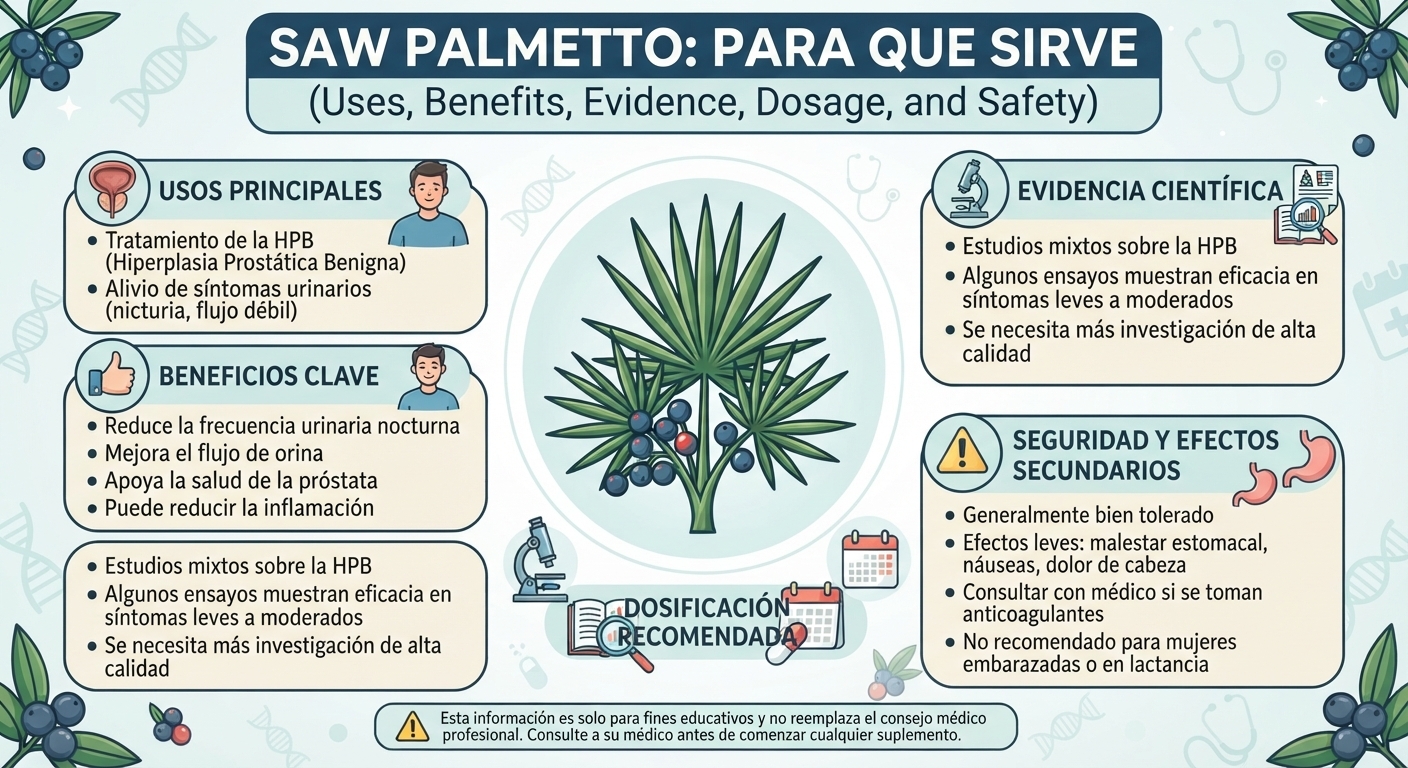
If you are searching saw palmetto para que sirve, you are probably trying to understand what this popular herbal supplement actually does and whether its advertised benefits are supported by research. The fruit of a small, palm-like tree native to the southeastern U.S., known scientifically as Serenoa repens. Saw palmetto supplements are most commonly marketed as capsules, softgels, extracts, or combination supplements. Saw palmetto’s most significant uses focus on the prostate, specifically related to urinary symptoms associated with Benign Prostatic Hyperplasia (BPH) but is also marketed to aid hair growth, improve prostate inflammation, and a number of other uses.
It should be noted, “Frequently used” should by no means be construed with “validated effective.”
The evidence for saw palmetto varies a significant amount from product to product and condition to condition, depending greatly upon the formulation utilized; according to NCCIH, there exists “not much strong clinical evidence to indicate that saw palmetto will prevent or improve BPH…” and lack evidence for it’s other uses.
What Is Saw Palmetto?
Saw Palmetto is a small, woody palm tree. It has been used historically in the treatment and prevention of a wide range of health issues. The berries have also been used traditionally and sometimes botanically are documented under one of the older names like Serenoa repens. Some sources state Serenoa serrulata, others Sabal serrulata.
Saw Palmetto is most often found as an extract made from the berries. Since methods of extraction and the final product itself can vary, and research can have widely diverse results depending on this formulation it is important to be aware of these factors.
Saw palmetto is most strongly associated with men’s health. It is frequently marketed for:
- Urinary symptoms related to an enlarged prostate
- Benign prostatic hyperplasia
- Male-pattern hair loss
- Chronic prostatitis or chronic pelvic pain
- General prostate support
Those uses should not be treated as equally established. Some have been studied extensively, while others have only limited clinical evidence.
Short definition
Saw palmetto is an herbal dietary supplement derived from the fruit of Serenoa repens. Saw palmetto is generally marketed as therapy for various prostate- and urinary- related disorders. It is also marketed as a treatment for hair loss. Its usefulness for any of these disorders has not been established.
Saw Palmetto Para Que Sirve for Prostate Health
The most usual reason given for taking this particular supplement is for its use in relation to prostate health and those stating this particular reason as being why they take the supplement were almost entirely patients having difficulties urinating as a direct result of an enlarged prostate. An enlarged prostate (benign tumour of tissue proliferation) is enlarged in size and the urethra is narrowed as a direct consequence which results in difficulties with full elimination of urine. Symptoms that might suggest enlargement of the prostate include: Urgency of urination, Nocturnal elimination of urine,Hesitancywith urination, Weak urinary stream and frequent urination.
So why do people claim Saw Palmetto to be beneficial to prostate health when there doesn’t appear to be much research that strongly confirms this to be true? Well it appears quite obvious that marketers of health related items know how much is being spent on supplements by consumers so this can be very tempting to try and add just that bit extra bit of information that’s guaranteed to make people buy whatever item is that particular product. Unfortunately this is perhaps not the definitive and “crystal clear” that the people taking these products claim that this would be based on.
With the Cochrane review in 2023, it looked at 27 trials to be identified that would assess the claims of the substance beneficial for BPH urinary symptoms but concludes “Saw Palmetto shows little or no benefit when used alone to reduce BPH urinary symptoms” with evidence on saw palmetto for benign prostatic hyperplasia providing further context.The strength of this is that the research analyzed is meta-analyzes of several clinical trials, not user experiences.
Why do some people still report benefits?
It is possible that people feel better even though there is no clinical evidence for many substances-the nature of the condition means there will always be fluctuations in the symptoms directly linked with intake of whatever has been taken-for example an increase in liquid intake, the amount of coffee that has been consumed and/or whether food and drink have been consumed before sleeping at night.
It is possible that the saw palmetto supplements will not all affect men differently. The saw palmetto supplements are diverse in their formulation – their manufacturers use either or all part(s) of the plant; there will also be variation of the percentage of active components in their supplement depending on its composition and preparation method. Additionally combinations of various natural agents will differ in their makeup – saw palmetto can be in combined with a drug or another herb. Both these scenarios cannot therefore say with certainty it is saw palmetto alone or in combination with other thing which works. According to NCCIH, it is not yet known whether there is enough evidence for combination of herbs including saw palmetto.
Does Saw Palmetto Shrink the Prostate?
That is a key difference. A BPH can cause these symptoms but they aren’t really the same thing, and it is theoretically possible that one would be able to fix the problem by supplementing that didn’t have a huge affect on the BPH itself, but on the symptoms related to the BPH.
There has been no evidence that the saw palmetto actually causes one to shrink a BPH. Old trials had contradicting results but newer well-constructed trials came up with very minimal results, little better then placebo. None of the BPH symptoms were seen to be caused by anything when using normal doses, and in studies with a larger dose they weren’t found to cause any of the BPH symptoms either (based on NCCIH data).
This indicates that when treating for the BPH and the symptoms alleviate, you cannot be sure whether it’s because the BPH had the treatment and the BPH symptoms reduced, or if it was just a coincidence with the supplement (and it really had nothing to do with the BPH).A person has need to see a doctor to find any sort of infection, or cause due to medication acting on the bladder.
What Does the Research Say About Hair Loss?
That is the other reason this can be marketed toward men. Saw palmetto can also be marketed toward male pattern baldness in terms of androgen dependent metabolic pathways; for that reason many people seem interested in seeing that a certain therapy can be targeted toward hair loss in men using an oral supplement or a topically applied agent. Where the problem comes into play here is the actual evidence that you are able to glean regardingSaw palmettouse in hair loss cases.
The NCCIH states there have been few trials investigating topical and oral uses of saw palmetto to study its efficacy in male pattern baldness concluding “more study is needed to ascertain Saw palmetto as treatment for male-pattern hair loss,” highlighting the limited research on saw palmetto for hair loss. When it’s impossible to give positive evidence that it either slows or reverses hair loss this is not an affirmation that there are no biologically active compounds actually involved, but that there is no clear and good enough information in order to properly educate and treat the public regarding the possible utility of saw palmetto for treating hair loss.
Also keep in mind, hair loss can be caused from a variety of situations such as; genetics, hormonal fluctuations, vitamin deficiencies, diseases such as thyroidism, specific drugs and inflammatory scalps, which is many more conditions. If a person is thinking about supplementing their diet in order to remedy the hair loss problem, this may or may not be useful to the patient. It would far better to determine causes for hair loss.
Can It Help With Prostatitis or Pelvic Pain?
Saw palmetto has also been considered for chronic prostatitis, a chronic pelvic pain syndrome. Chronic prostatitis may actually be a symptom group of related problems which lead to pelvic pain, urinary symptoms, and/or prostate-related pain and discomfort. The difficulty of this process can be particularly mystifying if there isn’t a clearly diagnosable bacterial etiology.
Regarding saw palmetto and this chronic pelvic pain syndrome, not much research exists.
NCCIH quotes the results of a systematic review conducted in 2022, which examined five studies; the analysis yielded no conclusive support for use of saw palmetto in the condition or chronic prostatitis. You should not assume that saw palmetto is part of standard evaluation or treatment for unspecified pelvic pain or prostate pain. Chronic pelvic pain syndromes should be comprehensively evaluated as disparate conditions can cause common symptoms that nonetheless necessitate disparate treatments.
How Is Saw Palmetto Usually Taken?

There are multiple dose sizes. The one that had the most research consisted of a concentrated extract designed to achieve a dosage of roughly 320 mg/day. The concentration per bottle does not relate to the concentration used in this particular study. Not all herbal preparations are necessarily equivalent simply because the plant itself is one.
Before taking a supplement, check:
- The amount of extract per serving.
- Whether the label specifies an extract or whole berry.
- Other ingredients included in the product.
- Suggested serving size.
- Manufacturer information and quality testing.
- Whether the product is intended for oral or topical use.
Don’t take any more just because you suspect an increased dose will be more effective – at least one NIH-sponsored study didn’t see any better urinary symptoms with a dosage up to three times normal and the placebo still had no beneficial effects. For prescription users or those with an underlying health condition it is best to discuss the supplement with your doctor.
What Are the Possible Side Effects?
Overall, saw palmetto is relatively well tolerated, in a survey the most frequently reported mild side effects include the previously mentioned stomach problems and additionally dizziness and headache according to NCCIH guidelines and in some studies. If any side effects are noticed and become noticeable or particularly strong it would be best to get off the saw palmetto and talk to a doctor immediately.
Just because a product is safe and well tolerated among the healthy, it doesn’t make it so for the public as whole.
Some population groups are less well-researched when it comes to safety than adult men. Here is a list for situations involving a higher risk, according to NCCIH guidelines: During pregnancy, During lactation.
Does Saw Palmetto Affect PSA Tests?
The PSA (prostate-specific antigen) is one type of test that might be part of prostate screenings and monitoring. [25]
The NCCIH’s evidence review seems to indicate that saw palmetto herb is not likely to affect PSA, even when tested at doses higher than are normally recommended.
This does not mean you don’t have a blood test drawn, or that PSA tests would become unnecessary while on the herb.
However, “normal”PSA readings do not account for all the things you might be looking for relating to your prostate.
Important Factors to Consider Before Buying It
There are many different supplements available, all containing some Saw Palmetto: however not all the capsules/tablets will contain the same mixture. Bottle may simply contain the actualSaw Palmettoutt, while others may combine Saw Palmetto together with vitamins or other plant extracts; or substances such as lycopene, some mineral including zinc and selenium, or other ingredients of sorts.
This brings the question about how the study was conducted.
When a study uses a combination, then a clinician’s findings cannot be taken as entirely due to the use of Saw Palmetto as there can be a variety of explanations for this: namely; a response to the Saw Palmetto or other compounds, their combined action, and effects of these compounds added to those mentioned above. It is actually stated by the NCCIH that there ‘is insufficient research on multiple-ingredient formulations’.
Consumers will find it important to be critical of complex supplements designed to treat prostate diseases, labeled “clinically proven,” as this may just indicate the evidence is for one of its components; find out precisely which one. Consider formulation, quantity of mixture being used per dose, and duration of administration; to whom it was administered; and what was being tested as this varies immensely.
Common Mistakes People Make
Assuming natural means proven
A plant-based ingredient can have biological effects without being proven effective for a particular medical condition.
“Natural” describes the source, not the strength of the evidence.
Using it instead of medical evaluation
Difficulty urinating, blood in the urine, pelvic pain, or significant changes in urinary habits should not automatically be treated with an over-the-counter supplement.
A supplement may delay evaluation of a condition that needs medical attention.
Expecting immediate results
Even when a supplement has evidence for a particular use, effects are not necessarily immediate. More importantly, saw palmetto has not been reliably demonstrated to improve BPH symptoms compared with placebo in high-quality evidence.
Taking more than recommended
More is not automatically better. Clinical research has specifically examined higher doses without demonstrating greater benefit for urinary symptoms.
Ignoring product differences
Two products may contain the same plant but use different extracts, concentrations, and additional ingredients.
Comparing labels matters.
Who Should Be Especially Careful?
If a person uses herbal therapies or other supplements along with their prescription medicine, it is advised to consult a physician before starting use, with whom they can discuss all herbal supplement use. It is good to keep health providers aware of complementary therapies. This is suggested from NCCIH so they know which herbs/medicines might have interactions with one another.
Extra caution is reasonable if you:
- Have a diagnosed prostate condition
- Have unexplained urinary symptoms
- Are being evaluated for prostate cancer
- Take several prescription medications
- Are pregnant or breastfeeding
- Have a history of significant reactions to supplements
- Are planning surgery or a medical procedure
Do not stop prescribed medication simply because a supplement is marketed as a natural alternative and safe use of dietary supplements should always involve consideration of possible interactions and individual circumstances.
Saw palmetto should also not be considered a substitute for evaluation when symptoms are new, worsening, or unexplained.
When Should You See a Doctor?
Symptoms like any other should be brought to your doctor’s attention if they are prolonged, intensifying, or if they become severe. Urinary retention, profound urinary bleeding, severe pain on urination, fever in combination with urinary complaints, or any other unexpected changes in your urinary bladder function should be a medical emergency-call your doctor immediately.
Mildly symptomatic complains of urinary changes should also be evaluated if the problems persist over an extended time; these can include voiding multiple times per night, difficulty voiding (hesitancy, abrupt stream cessation, dribbling at the end of urination), strong sensations while voiding( urgency) or gradually deteriorating stream, which significantly disrupt routine living or are concerned for some etiology of disease: Through physical examination, your doctor can discern if your complaint of symptoms correlates to a situation involving enlargement of the prostate, or if alternative conclusions may apply because of such causes for abnormal voiding;
Saw Palmetto: What We Know and What Remains Uncertain
The strongest takeaway is that the answer to saw palmetto para que sirve depends on separating traditional use and supplement marketing from clinical evidence.
| Potential use | What current evidence suggests |
| BPH urinary symptoms | Evidence overall does not show a reliable benefit when used alone |
| Enlarged prostate size | Not established as an effective way to shrink the prostate |
| Male-pattern hair loss | Evidence is too limited for firm conclusions |
| Chronic prostatitis/pelvic pain | Current evidence does not show a significant established benefit |
| General prostate support | Not established as a proven medical treatment |
| Safety | Generally well tolerated in studied adults, with mostly mild adverse effects |
NCCIH’s current assessment is particularly useful because it incorporates findings from multiple studies rather than relying on individual reports. Its 2025 consumer information concludes that saw palmetto is probably not helpful for urinary symptoms related to BPH and that there is insufficient evidence for several other promoted uses.
Final Takeaway
With regards to “saw palmetto para que sirve”, I would respond cautiously: it is an herbal supplement that is most widely promoted for the health of the prostate gland and urinary symptoms and even more claims for hair loss, other conditions. In fact, while the effectiveness of saw palmetto was extensively researched in relation to BPH, there does not appear to be strong evidence that saw palmetto itself will ameliorate urinary symptoms associated with an enlarged prostate; evidence for BPH is somewhat sparse as well. There is little research evidence to support the use of saw palmetto in managing pelvic floor chronic pain or hair loss.
Overall, the supplement appears to be quite safe, however, it may not be for everyone and it cannot replace a medical diagnosis.
If you or someone you know are thinking about taking saw palmetto as a substitute for seeing a doctor about an ailment such as BPH, pelvic floor chronic pain, or hair loss, please remember that you should discuss the particular supplement you’re considering, in addition to the symptom you wish to alleviate, with your physician, rather than “doing your own research online about its potential benefits.
FAQs
1.What is saw palmetto commonly used for?
Saw palmetto is a herbal supplement most commonly promoted for urinary symptoms associated with an enlarged prostate (BPH). It is also marketed for male-pattern hair loss and chronic pelvic pain, although evidence for these uses remains limited.
2.Does saw palmetto help with an enlarged prostate?
Current evidence does not show a reliable benefit. A 2023 review of 27 studies found that saw palmetto used alone provides little or no improvement in BPH symptoms.
3.Can saw palmetto shrink the prostate?
There is not strong evidence that saw palmetto reduces prostate size. Studies have also not established it as a dependable treatment for urinary problems caused by BPH.
4.Is saw palmetto effective for hair loss?
Saw palmetto is often marketed for male-pattern hair loss, but only a small number of studies have examined oral or topical preparations. The available evidence is too limited to determine whether it works consistently.
5.What are the side effects of saw palmetto?
Most people tolerate saw palmetto well. Reported side effects are generally mild and may include digestive problems, dizziness, or headache.
6.Does saw palmetto affect PSA levels?
Research indicates that saw palmetto does not appear to significantly change PSA readings, even when higher-than-usual amounts are used. However, prostate symptoms should still be medically evaluated rather than managed solely with a supplement.
7.Who should talk to a doctor before taking saw palmetto?
Anyone taking medications or managing a medical condition should discuss herbal supplements with a healthcare professional first because supplements can have safety concerns or interactions. Saw palmetto may also be unsafe during pregnancy or breastfeeding.
Conclusion
Understanding saw palmetto para que sirve requires separating popular claims from what research actually supports. While there’s much hype to treat prostate urinary symptoms, baldness and chronic pelvic pain it seems that currently, it has no proven benefits for BPH. Also Hair loss and chronic pelvic pain trials appear to lack the proof that benefit would be significant. Saw Palmetto seems well tolerated, possible side affects are minor stomach discomfort, giddiness and headaches, an advisable conversation with a doctor is advised.